Jeremiah, whom we see in our first reading, is a striking example of the irresistible force of God’s call, the seduction of which a person does not succeed in escaping. Nothing prepared Jeremiah for the mission he received. Extremely sensitive, timid, deeply attached to his fatherland and kin, he becomes a prophet of doom, obliged to antagonize the powerful and foretell ruin to those he loves. He certainly is not cut out for this mission. How, then, has he come to assume this role?
The whole initiative was from God, who chose him before birth. He protested, “I know not how to speak; I am too young .” But God brushed aside his objections. “Say not. ‘I am too young.’ To whomever I send you, you shall go; whatever I command you, you shall speak. Have no fear before them, because I am with you to deliver you….. See, I place my words in your mouth.” (Jer 1:7-9)
Jeremiah allowed himself to be seduced. God’s word is a “devouring fire.” Jeremiah is painfully experiencing that it is impossible from now on for him to evade his mission, whatever persecutions he undergoes. And this is how weak and frail persons become capable, under the Spirit’s impulse, to speak “on God’s part.” No-one can understand this without having experienced, at the very centre of the torment, the invincible attraction exerted by God.
In Caesarea, Simon Peter, speaking in the disciples name, confessed his faith in Jesus, “You are the Messiah, the Son of the living God.” In his turn, Jesus declared: “Blessed are you….. For flesh and blood has not revealed this to you, but my heavenly Father….. I will give you the keys of the kingdom of heaven.” This event marks a turning point in Matthews Gospel, which we shall see over the next few weeks. After Peter’s confession, “Jesus began to show his disciples that he must go to Jerusalem, and suffer greatly from the elders, the chief priests, and the scribes, and be killed, and on the third day be raised.” From this Sunday on, we are invited to look more intently toward the cross when we listen to the word and celebrate the Eucharist.
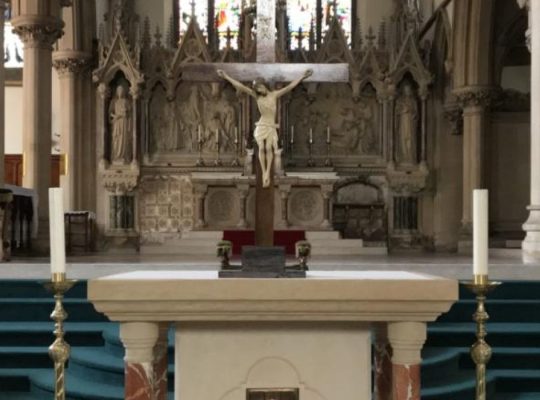
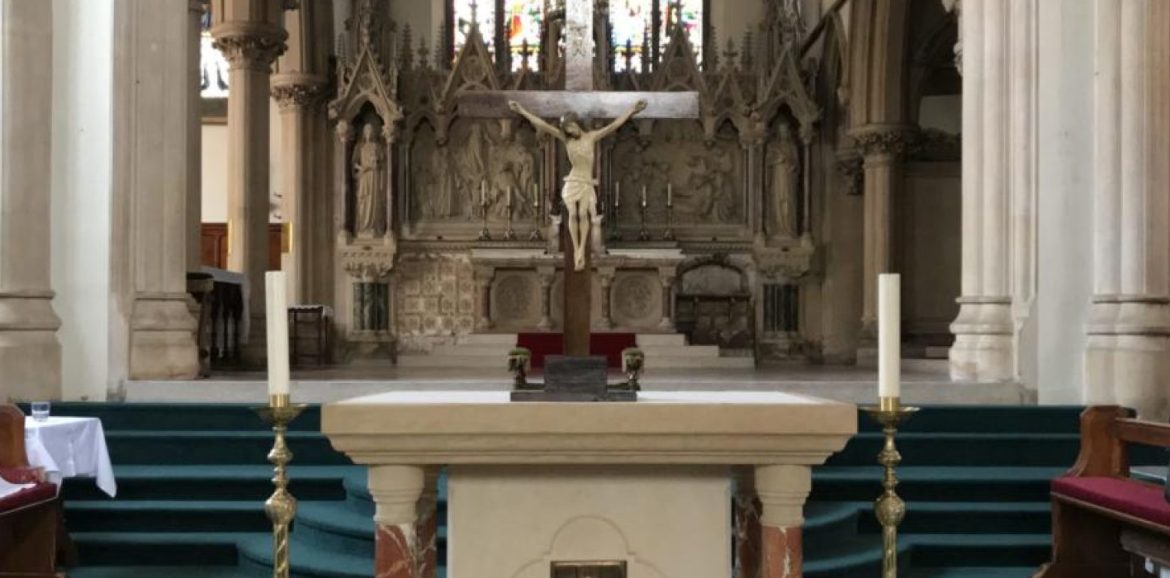
We are accustomed to the cross of Christ. It is found everywhere today in our everyday lives: in Churches and cemeteries, in our houses. We carry it on our persons as a an object of veneration, as a badge, as a jewel. The Lord is shown on it in glory, peacefully sleeping in death, sometimes with his body broken by suffering. For Jesus’ contemporaries, the cross was an infamous wood of punishment, the mere mention of which made one shudder. Who would not understand Peter’s violent reaction? How could the Messiah, the Son of God, be subjected to violent pain, then killed in Jerusalem, by the religious leaders of the people? “God forbid, Lord! No such thing shall ever happen to you.” “How, indeed, could we accept even the idea of such an end to him who manifested in his teaching and his acts an authority and a power never seen in a human being? If we admit so readily that Christ must suffer his passion, is it not because we do not dwell—except once a year— on Good Friday—on the scandalous reality?
Jesus feels Simon Peter’s reaction, though it is a human and spontaneous one, as an intolerable temptation coming from him. It perhaps reminds Jesus of Satans’ in the desert; he insidiously suggested to Jesus that he deviate from the way marked out by the Father. “Get behind me Satan! You are an obstacle to me. You are thinking not as God does, but as human beings do.” In effect, “How can you say such a thing after the revelation you received from the Father?” Yes, how was this possible? Because Peter remained a human being. This sincere and enthusiastic faith of the typical believer had to confront—as must our own faith—in a harsh battle— the scandal of a Messiah suffering and put to death. This faith of Peter’s knew the humiliation of denial during the Lord’s passion. One would think that Peter did not listen to the end of what Jesus was saying, that he missed the announcement of the resurrection “on the third day.” In fact, all the disciples were surprised on Easter Day. The day after the sabbath, Mary Magdalene and the other Mary went to the sepulchre to complete the embalming of the crucified one. Their discovery of the empty tomb troubled the apostles; and Peter, who ran to verify their story on the spot, remained amazed. The appearance of the risen one in the upper room disturbed the eleven. As at the quelling of the storm, they thought they were seeing a ghost. But on Pentecost day, they at last understood that Christ had to suffer much and be killed in order to rise on the third day. Then Peter boldly proclaimed, “God made him both Lord and Messiah, this Jesus whom you crucified.” (Acts 2:36) To come to this faith, we must—and this is not accomplished in one instant—go from human thoughts to God’s thoughts.
But the Gospel does to stop here. Having announced his passion, Jesus immediately speaks of his disciples’ destiny. “Whoever wishes to come after me must deny himself, take up his cross, and follow me.” “To carry one’s cross” has become a standard expression of Christian language to mean “to bear trials with courage and faith.” Paul viewed in this manner the trials that were rife in his apostolate; he saw in them a sharing in the sufferings of Christ and in his passion. But what Jesus says here is more precise and has more general import. He addresses the disciples and no longer only Peter. “To take up one’s cross” and ”to follow Jesus” go hand in hand. Whatever the circumstances of their existence, all disciples must, on account of Jesus, lose their lives to save them. This means that we must lose possession of ourselves in order to gain life, to seek the realities above, where Christ is seated at the right hand of God, and not the earthly realities. For we have died with Christ, and our life remains hidden in God. When Christ our life appears, then we, too, will appear with him in glory. What Paul wrote to the Colossians (Col 3:1-4) is a commentary on the application of Jesus’ words to his disciples. For whom and for what do we live? The answer to this question resides in what we do; either we follow Christ, as Peter finally did, or else we remain an obstacle in his way.
We can give many reasons for being attached to someone with our whole beings, but “Love cannot be discussed.” None of these reasons, not even all of them taken together, are the reason that explains love. So much so that love and faithfulness remain even after the disappearance of what could have explained them. The same is true—even more so—when we give our faith to God. This is the experience attested to by Jeremiah, in whom all believers can recognise themselves. He was deeply conscious of not having the makings of a hero that were necessary to confront difficulties so contrary to his nature. He fights. He goes so far as to reproach God for his behaviour. But he must admit to being defeated by God’s irresistible force acting within him. “You seduced me, and I allowed myself to be seduced.”
How, indeed, could we resist God’s tenderness when it manifests itself? We want to devote to him our whole life, our whole person, we want to offer our lives to him to please him, thus responding to his love by a lifelong sacrifice of adoration.
Jesus had opened the way that leads to a more perfect union with God, up to the sharing of his glory with Christ. It is a disconcerting way because it goes through suffering and death in the footsteps of the Messiah, the Son of God. We do not set out on this way without hesitation, even indifference. But we know that to lose one’s life is to save it. The Eucharist, the memorial of the death and resurrection of the Lord, is a profession of faith in action, while we await the day when Christ will come with his angels in the glory of his Father and when the Son of Man will render to all according to their actions.
And so, in today’s readings we see the Church is assured it will not be conquered by the powers of evil and death. It is made of up of men and women whose faith, yes, remains fragile, imperfect believers who nevertheless remain attached to him who has seduced them. From them Jesus has chosen stewards, with Peter as their leader. He gave him the keys of the kingdom of heaven that he might exercise among his brothers and sisters the ministry of unity, that he might be the humble and watchful guardian of faith in Christ, the Son of the living God, who suffered, was put to death, and rose again on the third day.
“For you my soul is thirsting, O Lord my God.”